




At My Wedding, My Mother Looked at My Bride and Whispered, ‘That’s Not Her Real Face’
 June 17, 2026
The garden venue glowed beneath a sky so blue it looked painted.
White roses lined the aisle, a string quartet played beneath a canopy of oak trees, and more than two hundred guests filled rows of white chairs facing the altar.
Everything was perfect.
Or at least it should have been.
I stood at the front in a gray suit, trying to steady my breathing as the music changed and everyone rose to their feet.
At 32, I’d spent most of my life building things.
Buildings. Plans.
Emma was the first thing that had ever happened to me that I hadn’t planned.
Two years earlier, she’d walked into a coffee shop on a rainy Tuesday afternoon and smiled at me over the last empty seat.
Now she was about to become my wife.
The doors at the far end of the aisle opened, and there she was.
For a moment, everything else disappeared.
The guests.
The music.
The flowers.
All of it.
Emma stepped into the sunlight in a simple ivory gown, her dark hair pinned back in loose curls.
She looked breathtaking.
I smiled.
Then my glance glazed toward the front row, and my smile vanished.
My mother looked terrified. Not emotional or overwhelmed.
Terrified.
Her fingers gripped her beaded purse so tightly her knuckles had turned white.
She was staring at Emma, and the closer Emma came to the altar, the worse my mother looked. By the time Emma reached my side, Mom looked as though she’d seen a ghost.
Then she leaned forward.
Her voice was so quiet I almost didn’t hear it.
“Daniel.”
I turned slightly.
“What?”
She swallowed.
Then whispered:
“That’s not her real face.”
Every muscle in my body locked.
“What?”
But she’d already sat back down.
The officiant began speaking, the ceremony continued, and I didn’t hear a single word.
I wish I could tell you I stopped the wedding.
I didn’t.
I wish I could tell you I demanded answers immediately.
I didn’t do that either.
Instead, I stood there and married the woman I loved while my mother’s words echoed inside my head.
Every time I looked at Emma, I heard it again. Every smile, every glance, every promise.
When the ceremony ended, the guests applauded.
Emma kissed me, everyone cheered, and for the first time since I’d met her, I felt afraid. Not of her.
Of what I didn’t know.
The reception was held on the opposite side of the property beneath a massive glass pavilion. People kept stopping us for photographs, champagne toasts, and congratulations.
I smiled when I was supposed to smile and laughed when I was supposed to laugh.
The entire time, I searched for my mother.
Finally, nearly an hour later, I spotted her slipping through a side corridor toward one of the private sitting rooms.
I followed.
The moment I stepped inside, I shut the door behind me.
She was standing by the window.
Waiting.
As though she’d known I would come.
“Mom.”
She didn’t answer.
“Tell me what you meant.”
Still nothing.
“Mom.”
Slowly, she opened her purse, then removed an old photograph. The edges were worn, and the colors faded. She held it out to me.
“Look.”
I took it.
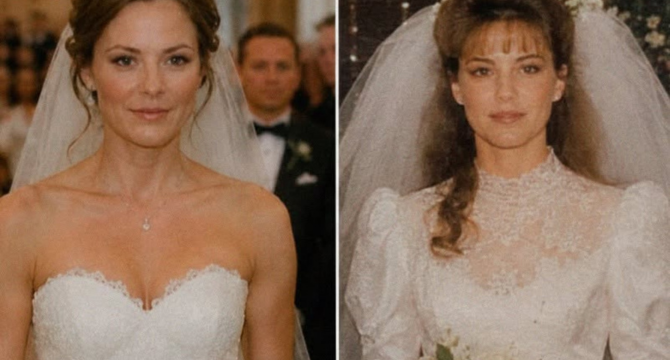
At first, it looked like an ordinary wedding picture.
A young bride.
A dark-haired groom.
A little girl standing between them.
Then my eyes returned to the bride.
And my stomach dropped.
She looked exactly like Emma.
Not similar.
Not related.
Exactly.
Same eyes, same smile, same tiny mole near her eyebrow.
I looked at my mother.
Then back at the photograph.
“No.”
“Turn it over.”
My hands felt numb as I flipped it.
A date was written on the back. The photograph had been taken 26 years ago, a full year before Emma was supposedly born.
I stared at the date, then at the bride, then back at the date.
Nothing made sense.
“Who is she?”
My mother swallowed.
“The bride’s name was Catherine.”
The name hung in the air.
“I worked with her for years.”
“You knew her?”
“Not well.”
Mom looked at the photograph.
“But well enough to know that woman isn’t Emma.”
Before I could respond, the door behind us opened.
I turned.
Emma stood in the doorway. One hand still holding part of her veil.
At first, she looked confused. Then she saw the photograph, and the color drained from her face. For several seconds, nobody moved.
Then Emma took one step forward.
Then another.
Her eyes never left the picture.
“Where did you get that?”
The question came out barely above a whisper.
I looked down at the photograph.
Then back at her.
“Do you know this woman?”
Emma didn’t answer.
Instead, she crossed the room and stopped beside me.
Her gaze moved across the image, and a strange sound escaped her throat.
“Emma?”
She reached toward the photograph with trembling fingers.
“Who gave this to you?”
My mother frowned.
“Why?”
For the first time since I’d met her, I saw genuine fear in Emma’s eyes.
“Please.”
Her voice cracked.
“Tell me who gave it to you.”
My stomach tightened.
Because suddenly I wasn’t wondering who Catherine was. I was wondering why Emma was so terrified of a twenty-six-year-old photograph. And why she seemed to know exactly where it had come from.
Emma’s hand hovered over the photograph.
Not touching it. Not quite. As if she were afraid contact might somehow make it real.
“Who gave this to you?” she asked again.
My mother studied her carefully.
“It was delivered to my house yesterday.”
Emma closed her eyes.
For a moment, she looked as though she might collapse.
Yesterday, not twenty years ago.
Not recently uncovered.
Yesterday.
Somebody had deliberately sent it.
The realization sent a chill through me. “Who delivered it?” I asked.
My mother shook her head.
“There was no note.”
“No return address?”
“No.”
Emma looked away.
And somehow that frightened me more than anything she’d said. She wasn’t acting confused. She was acting like someone whose worst fear had finally arrived.
“Emma.”
Before anyone could speak, a knock sounded at the door.
All three of us jumped.
The door opened, and my best man leaned inside.
“There you are.”
Then he noticed our faces, and the tension and his smile disappeared.
“Uh…”
He held up a folded place card.
“I know this sounds weird, but is one of you Catherine?”
Every muscle in Emma’s body locked.
My pulse quickened.
“What?”
My best man looked uncomfortable.
“There was a seating card mixed in with the extras.”
He handed it to me.
I stared.
Written in elegant black script was a single name.
Catherine.
Not Emma.
Catherine.
The card looked identical to all the others. Same paper, same font, same printing. As if it belonged at one of the reception tables. As if somebody named Catherine was supposed to be at my wedding.
I looked up.
Emma had gone pale.
“What is this?” I asked.
Nobody answered.
My best man shifted awkwardly.
“I figured it was a mistake.”
Then he glanced at Emma and immediately stopped talking. He had noticed what I had.
Fear.
Raw fear.
“I’ll…”
He pointed toward the hallway.
“Go.”
The door closed behind him, and the second it did, I turned toward Emma.
“Enough.”
She flinched.
“I deserve an explanation.”
She looked at the photograph, and for several seconds she seemed unable to speak.
Finally, “The woman in that photograph was my mother.”
I blinked.
“What?”
“My mother.”
My mother frowned.
“Catherine?”
Emma nodded.
The room fell silent.
Because suddenly everything had changed.
Not solved. Changed.
I looked at the photograph again.
The bride, the little girl, the impossible resemblance, ten back at Emma.
“Then why did my mother say that wasn’t your real face?”
Emma laughed softly.
A broken sound.
“Because she thinks I’m Catherine.”
The words hung between us.
My stomach tightened.
“What does that mean?”
Emma stared at the picture, then said something that made every question in my head multiply.
“Because everyone believes Catherine died 22 years ago.”
Nobody spoke. I waited.
Then, “But I don’t think she did.”
My mother stared.
I stared.
And for the first time, I realized this wasn’t a secret Emma had been hiding from me. It was a mystery she’d been trying to solve herself.
“You think your mother is alive?”
Emma nodded, slowly, carefully.
As if saying it out loud still felt dangerous.
“I’ve thought that for years.”
“Why?”
She looked at me.
“The records don’t match.”
“What records?”
“The death certificate.”
My mother frowned.
“What are you talking about?”
Emma took a shaky breath.
“The date changed.”
Silence.
Then:
“What?”
“The first copy I found listed one date.”
She swallowed. “The second listed another.”
My pulse quickened.
“That doesn’t prove anything.”
“I know.”
Her eyes filled with frustration.
“The hospital records were missing.”
“That doesn’t prove anything either.”
“I know.”
“But then I found someone who remembered her.”
I leaned forward.
“Who?”
Emma hesitated before answering simply, “A nurse.”
My mother frowned.
“A nurse from 22 years ago?”
Emma nodded.
“She told me something she probably shouldn’t have.”
“What?”
Emma looked down at the photograph, then back at us.
The fear had returned, only this time, it looked stronger now.
“She told me my mother walked out of that hospital.”
Nobody spoke.
The words seemed impossible.
Finally, my mother whispered:
“That’s not possible.”
“I know.”
“But that’s what she told me.”
The silence stretched.
Because if Catherine had walked out of that hospital, then somebody had lied about her death and what happened afterward.
About everything.
And suddenly I understood why Emma had reacted the way she had.
The photograph wasn’t the problem; it was proof that somebody else knew and was watching.
Proof that whatever secret Catherine had taken with her decades earlier wasn’t buried anymore.
Then Emma looked at the place card again.
And quietly said:
“She knows I’m here.”
My heart skipped.
“What?”
Her eyes moved across the room toward the reception and the hundreds of guests beyond the walls. And when she spoke again, her voice barely rose above a whisper.
“Because Catherine is the only person who ever called me by that name.”
For a second, I wasn’t even sure I’d heard her correctly. “What name?”
Emma looked at the place card.
Then back at me.
“Catherine.”
The room seemed to tilt.
I stared at her.
“Your name is Emma.”
She nodded.
“I know.”
“Then why would your mother call you Catherine?”
A sad smile crossed her face.
“Because that was the name she gave me.”
My pulse quickened.
“What?”
“I changed it when I was eighteen.”
Every answer seemed to create three new questions.
My mother looked just as lost as I felt.
“Why would you do that?”
Emma hesitated, then laughed softly.
“Because I spent most of my life trying not to be her.”
Silence.
Then:
“And the older I got…”
She glanced at the photograph.
“…the harder that became.”
The little girl in the picture, the bride, and the impossible resemblance. For the first time, I noticed something I should have seen earlier.
My mother had been right. Emma didn’t merely resemble Catherine; she was almost a mirror image.
The same face.
Just two decades younger.
A chill ran through me.
“Emma.”
Her eyes met mine.
“If your mother called you Catherine…”
I held up the place card.
“And this showed up today…”
I swallowed.
“Then you think she sent it.”
Emma nodded slowly.
“I do.”
“Why?”
The answer came immediately.
“Because it’s something she used to do.”
“What?”
“When I was little, she’d leave notes for me.”
A pause. “Never signed, never explained, just enough information to make sure I found what she wanted me to find.”
My mother frowned.
“You think she’s communicating with you?”
“I think she’s trying to.”
Nobody liked how that sounded, least of all me. Because it implied something terrifying.
Not that Catherine was alive, that she’d been close enough to send the photograph, close enough to leave the place card, close enough to know where the wedding was happening.
Then another thought hit me.
Hard.
“If she wanted you to know she was here…”
I looked toward the reception.
“Why not just come talk to you?”
Emma’s expression changed.
Recognition.
As though I’d finally asked the right question.
“Because she doesn’t know if I’ll want her to.”
The answer landed heavily.
“Why not?”
Emma opened her mouth, then stopped. For a moment, she seemed to be debating something internally.
Finally:
“Because if she could…”
Her voice cracked.
“…she would’ve done it years ago.”
The room fell silent.
Then my mother spoke.
“The groom.”
All eyes turned to her.
“What?”
Mom pointed at the wedding photograph.
“The groom.”
She took the picture from my hands.
She wasn’t looking at Catherine.
She was looking at the man standing beside her.
“Nobody’s talking about him.”
I frowned.
Because she was right.
The entire time we’d been focused on Catherine.
The groom had become background.
A prop, a detail.
And yet he was standing in the center of the photograph.
The man who had supposedly raised Emma, the man who had supposedly lost his wife, the man whose version of events Emma had grown up believing.
“What about him?” I asked.
Emma’s face immediately darkened.
That was all the answer I needed.
My mother noticed it too.
“Emma.”
Silence.
“Who told you Catherine died?”
The room went completely still. Suddenly, the answer seemed obvious.
Emma looked away. And in doing so, answered the question without speaking.
Her father.
The only person who had been there, the only person who would’ve known, the only person who had spent decades controlling the story.
My pulse quickened.
“Is he alive?”
Emma nodded.
“Yes.”
“Have you asked him?”
A bitter laugh escaped her.
“About a thousand times.”
“What did he say?”
“The same thing every time.”
She swallowed.
“That my mother abandoned us.”
There it was.
The first crack.
Not she died. She abandoned us.
A completely different story.
And suddenly the contradictions started piling up.
The missing records, the conflicting dates, the nurse, the photograph, the place card.
None of it fit together.
Not with abandonment.
Not with death.
Not with anything.
Then Emma looked down at the place card again.
“She’s here.”
“You don’t know that.”
Emma met my eyes.
“I do.”
Then she turned and headed for the reception. I followed immediately, and so did my mother.
The three of us emerged beneath the glass pavilion into a sea of conversations, laughter, music, and champagne glasses.
Two hundred guests, two hundred faces.
And somewhere among them, according to a woman who might not even exist, was the answer.
“Guest list,” Emma said.
“The guest list.”
My best man was standing near the bar when we found him.
“Daniel?”
“I need the seating chart.”
He blinked.
“Right now?”
“Right now.”
Something in my voice convinced him not to ask questions.
A minute later, we were gathered around a table near the event office, scanning pages of names.
Friends, family, coworkers, plus-ones, vendors. Nothing stood out.
Then Emma froze.
Her finger stopped halfway down the final page.
“What?”
She didn’t answer; she simply pointed.
One name. No last name. No table assignment.
Just:
Catherine.
A chill ran through me.
“Who added this?”
The wedding coordinator was summoned.
She arrived looking confused, then increasingly uncomfortable.
“Actually…”
“What?” Emma asked.
The coordinator swallowed. “That guest wasn’t on the original list.”
The room seemed to tighten around us.
“Then how did it get there?”
She hesitated.
Then:
“The request came from the bride.”
Emma stared at her.
“What?”
The coordinator frowned.
“I assumed it was you.”
“No.”
The woman looked genuinely alarmed.
“I received an email three weeks ago.”
Three weeks.
Emma went still.
“Do you still have it?”
“Maybe.”
She hurried away.
Emma looked pale.
But she was no longer frightened.
She looked focused, determined, as though pieces were finally beginning to connect.
Several minutes later, the coordinator returned holding her phone.
“I found it.”
She handed it to us. The message was short.
“Please reserve one seat.”
“Name: Catherine.”
No table preference, no thank you, no signature, no explanation.
The sender’s email address was a random string of letters and numbers. Impossible to identify.
But beneath the message sat one detail that made Emma grab my arm.
The timestamp.
Three weeks ago.
The exact day she’d received the first clue suggesting Catherine might still be alive.
Emma stared at the screen.
Then whispered, “She knew.”
“What?”
“She knew I’d finally found her.”
Before I could respond, my mother touched my shoulder.
She was looking across the reception, toward the dance floor, toward a table near the back.
“Daniel.”
I followed her gaze.
A woman was standing alone.
Perhaps in her late fifties, dark hair streaked with gray, simple navy dress.
Nothing remarkable about her. Except she was staring directly at Emma, and the moment Emma turned and saw her, the color drained from her face.
Nobody moved.
The distance between them couldn’t have been more than 30 feet.
Yet it felt impossibly large.
“Is it her?” I whispered.
Emma’s eyes filled with tears.
“I don’t know.”
The answer surprised me. Then I understood. Of course, she didn’t know.
She’d spent 22 years looking at photographs.
Photographs never age, people do.
The woman slowly set down her glass.
Then took one step forward.
Emma stopped breathing.
Another step.
Then another.
The reception continued around us. Nobody else seemed aware that an entire life might be changing at the edge of the room.
The woman stopped a few feet away.
For several seconds, neither of them spoke.
Then the woman smiled.
A small, sad smile.
And said:
“You kept your father’s eyes.”
Emma’s hand flew to her mouth.
Not because the sentence proved anything. Because of the way she said it.
The familiarity, the certainty, the love.
The woman reached into her purse and removed something folded.
It was an old photograph.
She handed it to Emma.
I stepped closer, and so did my mother.
The picture showed a young woman holding a baby who couldn’t have been more than a few months old. On the back, written in faded blue ink, were four words.
My beautiful Catherine.
Emma stared at the handwriting.
Then looked up.
Her voice barely worked. “How do you have this?”
The woman’s eyes glistened.
“Because that’s me holding you.”
The world seemed to stop.
For a moment, nobody moved.
Then Emma asked the question that had shaped her entire life, the question hiding beneath every other question.
“Why did you leave?”
The woman closed her eyes. Pain crossed her face.
When she opened them again, tears were running down her cheeks.
“I didn’t.”
Just two words.
But they changed everything.
Emma stared.
The woman swallowed.
“Your father told you I left.”
Emma nodded, slowly.
The woman laughed once. A broken sound.
“He told me you’d be safer if you believed that.”
Silence.
Then:
“I spent 22 years trying to find a way back to you.”
Emma began crying. Catherine did too.
Then they stepped toward each other and embraced.
After decades apart, neither seemed willing to waste another second.
Later, Catherine told us what had happened.
Emma’s father had spent years controlling nearly every part of her life. When Catherine finally tried to leave, he convinced her that staying away was the only way to keep her daughter safe.
It was a terrible decision.
One that cost both of them 22 years.
Neither woman tried to pretend those years hadn’t happened. Some losses were simply too large for that.
But for the first time, they were carrying them together.
A little later, my mother quietly slid the old wedding photograph across the table, the one that had started everything.
Catherine stared at it for several seconds.
Then laughed through tears.
“I haven’t seen this in years.”
Emma looked down at the image.
The young bride, the little girl standing beside her, the life that should have been.
Then she looked up.
“Catherine.”
Her mother smiled. The name sounded different now. It was no longer a mystery, no longer a ghost.
Just a mother.
“Can I keep it?” Emma asked.
Catherine nodded immediately.
“Of course.”
Emma traced the edge of the photograph with her thumb.
For most of her life, she’d searched for answers. For proof. For something that explained the empty space she’d carried since childhood.
What she found wasn’t an answer.
It was a person.
And somehow that mattered more.
Before the night ended, the photographer gathered everyone for one final picture.
This time, Catherine stood beside Emma.
The camera flashed.
And just like that, a new photograph joined the old one.
Years later, both pictures still sit side by side in our home.
One captured a mother and daughter moments before they lost each other, the other captured the day they found their way back.
Whenever I look at them, I think about how close we came to missing it all.
A photograph delivered at the right moment, a whispered warning, a wedding day that became something none of us expected.
Emma spent years searching for the truth about her mother.
What she eventually discovered was something much simpler; her mother had never stopped searching for her, too.