



I Returned From a Business Trip, and My 4-Year-Old Daughter Asked, ‘Daddy, Will My Other Dad Have Lunch With Us? He’s Sitting in the Basement’ – I Went Downstairs, and What I Saw Made My Blood Run Cold
 June 15, 2026
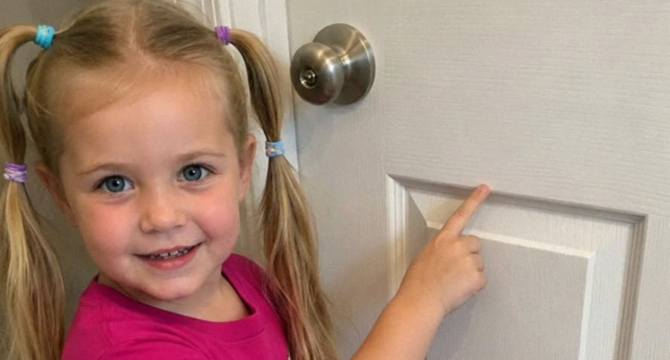
My daughter has always had a way of saying things that stop the whole room.
Gabriella, Gabby to everyone who knows her, is four years old and has never once understood the difference between what you think and what you say out loud.
My daughter has always had a way of saying things that stop the whole room.
I’d been home maybe twenty minutes. I’d flown back a day early from a work trip and walked through the front door into a burst of noise and warmth.
Gabby launched herself at my knees. My wife, Heidi, hugged me over her head and asked why I hadn’t called to tell her I was coming home early.
There was something uneasy in her eyes, but I brushed it off.
There was something uneasy in her eyes.
What I didn’t notice, at least not right away, was how often my wife kept glancing toward the hallway where the basement door was. I only understood any of it after Gabby said what she said.
We sat down for lunch, and I was just beginning to relax into the normality of being home.
Then Gabby looked at me with her soup spoon mid-air and said, “Daddy, is my other dad going to eat with us?”
“Your other dad?”
“He’s in the basement,” she said, perfectly matter-of-fact, the same way she’d tell me unicorns were real.
“Daddy, is my other dad going to eat with us?”
I looked at Heidi.
She had gone completely still.
“Gabby’s making things up,” she said too fast. “You know how she gets.”
But Gabby had never invented an “other dad” before.
I set my spoon down.
She had gone completely still.
The thoughts came fast and without mercy. Four days away. Heidi alone in the house. Someone in our basement. Someone Gabby had met enough times to call him “other dad.”
Heidi stood up when I did. “Larry, please. Don’t go there.”
“There’s someone in our basement?”
“It’s not what you think.”
“Larry, please. Don’t go there.”
I walked to the basement door.
She grabbed my arm. “Please don’t go down there. I’ll explain everything. Please.”
I looked at her hand on my arm.
Then I opened the door.
The smell hit me first.
“Please don’t go down there.”
Not unpleasant, just close, the smell of a room that had been lived in.
I stopped on the second step and reached for the light cord.
The bulb came on.
There was a couch I didn’t recognize along the far wall. A small table with a lamp on it. A blanket folded over the armrest. A cup. A book lying face-down on the cushion, like someone had just set it down.
There was a couch I didn’t recognize along the far wall.
And a man sitting in the corner on an old chair, squinting against the sudden light.
For a full second, I thought I was looking in a mirror.
He had my face, my jaw, and the same dark eyes, right down to the slight asymmetry at the outer corner of the left one. But he was thinner, grayer at the temples, and worn in a way that hit me before I could make sense of it.
I hadn’t seen him in almost fifteen years.
“Simon?”
“Hey, Larry.”
I thought I was looking in a mirror.
My twin brother’s voice was exactly the way I remembered it.
We looked at each other across the length of that basement, and fifteen years collapsed between us in the worst possible way.
And then the thing that had been building since the moment Gabby said “other dad” came flooding in.
I started shouting, assuming the worst.
Fifteen years collapsed between us in the worst possible way.
I said things I won’t fully repeat here.
I told him he had no right to come back after all the choices he’d made, choices our late parents and I had warned him against. I told Heidi that she had betrayed me in my own house.
And I said other things too, louder things, the kind that only come out when fear curdles into anger and your mind is convinced your wife has betrayed you with your own brother.
Gabby had followed me to the top of the stairs, and she was crying. But even that didn’t slow me down.
She had betrayed me in my own house.
Simon didn’t shout back. He stood up slowly, gathering his jacket from the back of the chair, folding it over his arm with the careful movements of someone who has been very tired for a long time.
He looked at me the whole time.
“I’ll go, Larry.”
He came up the stairs past me without touching me. He paused at the top to look at Gabby, and something shifted in his face for just a moment, something quiet and private.
He paused at the top to look at Gabby.
“Bye, sweetheart,” he told her. “Be good to your dad.”
Gabby reached for him. “Other Dad, don’t go.”
He touched the top of her head once, gently, and then walked to the front door and out of it, and I stood in my hallway and listened to the sound of it closing.
Then I turned to Heidi.
“What was my brother doing here?”
“Other Dad, don’t go.”
“Larry, please. It’s not what you think.”
“Then tell me what it is.”
She looked at me for a long second, like she knew there was no way around it now.
Then she told me everything.
Simon had reached out the month before, only a few days before I left for the trip.
She knew there was no way around it now.
Not to cause trouble. Not to ask for money. He called from a number Heidi didn’t recognize, and she almost didn’t pick up. When she heard his voice, she said she had to sit down.
My brother had been diagnosed eight months earlier. Late-stage pancreatic cancer.
He spent those months alone in an apartment across the city, going to appointments by himself, and handling all the paperwork and arrangements that come with dying when there’s no one else there to help.
He called Heidi because he didn’t know who else to call.
She almost didn’t pick up.
He told her he didn’t want anything from us. He just needed to hear a voice that remembered him from before any of this.
She had listened for an hour.
Then she’d gone to see him, and she’d seen the apartment, and she’d come home and spent three days trying to figure out how to tell me.
“Every time I started,” she said, “you’d hear his name and just shut down. You’d change the subject. I didn’t know how to get past that.”
She’d gone to see him.
So she hadn’t. Instead, she’d quietly set up the basement. She’d told herself she would tell me soon.
She told herself that for weeks.
I sat at the kitchen table with my hands flat on the surface and listened to my wife explain why my dying brother had been sleeping thirty feet below our bedroom for weeks.
The anger drained out of me slowly, replaced by shame.
My dying brother had been sleeping thirty feet below our bedroom.
We were in the car in under ten minutes.
Gabby was buckled into the back seat, still clutching the drawing she’d been working on when everything fell apart. Simon had apparently helped her with it over several afternoons.
Two stick figures, a smaller one between them, and a crooked yellow sun in the corner.
We went to Simon’s apartment first.
The door wasn’t locked.
We went to Simon’s apartment first.
Inside, the rooms were nearly empty in a way that confirmed everything Heidi had told me. A mattress on the floor. A folding chair. A stack of papers on the kitchen counter: medical documents, appointment reminders, a form I recognized as an advance directive.
A row of orange prescription bottles lined up on the windowsill with the particular neatness of someone managing their days in increments.
There was no sign of where he’d gone.
Inside, the rooms were nearly empty.
On the kitchen counter, beneath a stack of medical papers, I found an old photograph folded almost in half from years of being handled.
It was the two of us as boys sitting on our father’s shoulders at a county fair.
Simon had drawn a small circle around my face with a blue pen years ago.
I stood there staring at it, realizing that while I had spent fifteen years trying to forget him, he had been carrying me around in his apartment the entire time.
I had spent fifteen years trying to forget him.
We checked the bus station. A late-night diner we’d both frequented years ago. A shelter two neighborhoods over, where a volunteer recognized my description but hadn’t seen him.
The city felt enormous. Full of dark streets and closed doors.
Gabby fell asleep somewhere in the second hour with her cheek against the window and the drawing still in her hand.
I drove and thought about Simon.
We checked the bus station.
I thought about the last real conversation we’d had. The things that had been said. The things I had decided to treat as final.
Fifteen years is a long time to treat something as final.
Then a memory surfaced, not a thought exactly, more like a direction.
When we were boys, whenever things became too much, there was only one place Simon ever went.
There was only one place Simon ever went.
The cemetery was dark except for the lights along the main path, and I drove slowly with the window down, scanning the grass on either side.
I found him near the back, off the path, lying on his back in the grass beside two headstones I knew by heart. His hands were folded on his chest, and he was looking straight up at the sky.
I parked and got out and walked toward him, and he didn’t hear me until I was close. Then he turned his head, and for a moment neither of us said anything.
I sat down beside him in the grass.
I found him near the back.
The headstones bore our parents’ names. The dates. The small inscriptions we had chosen together at a time when we were still the kind of brothers who chose things together.
I don’t know how long we sat there before I started talking.
I didn’t plan what I said. It came out in pieces.
I don’t know how long we sat there.
I apologized for things I named and for things I could only gesture toward. I told him I had been so certain, for so many years, that I was the one who had been wronged, that I had never once asked whether he was okay.
By the time I stopped talking, Simon’s face was wet.
He didn’t say I forgive you or it’s fine or any of the things people say to make difficult moments easier.
He just said, “I didn’t come back because I thought I deserved anything. I just wanted to be near family. Just at the end. That’s all I wanted.”
“I just wanted to be near family.”
I put my arm around my brother’s shoulders, and he leaned into it, and we sat there beside our parents’ graves in the wet grass while the city made its distant sounds around us.
I thought about all the years I had spent being certain I was right, and how much they had cost both of us.
Gabby woke up when we got back to the car.
She looked at Simon in the passenger seat with the immediate, uncomplicated joy of a child who hasn’t yet learned to make things complicated. She reached forward from her car seat and patted his shoulder with both hands.
I put my arm around my brother’s shoulders, and he leaned into it.
“You came back!” she chirped, like it was the most obvious thing in the world.
“I came back.”
She settled back into her seat. “Good,” she said, and closed her eyes again.
Simon stayed for seven months.
We moved him into the spare room upstairs, where the window caught the morning light. He and Gabby slipped into a routine of their own, and I wasn’t always part of it. That was fine.
Simon stayed for seven months.
There were drawings, slow walks around the block, and a card game she had half invented while he smiled and played along.
She never stopped calling him Other Dad. We stopped trying to correct it.
There were hard days. Days Simon was too tired to leave the bed, and Gabby would sit outside his door singing quietly to herself. Days he and I sat at the kitchen table after everyone else was asleep, talking about things we had never said, the way you talk when you know the time is finite.
Simon wasn’t afraid, exactly. He said that once.
She never stopped calling him Other Dad.
“I’m not afraid. I was. But not now.”
I asked him what had changed.
He looked around the kitchen. At the crayon drawings stuck to the refrigerator. At the coffee cups Heidi had left drying on the rack. At all the small evidence of a family living inside a home.
“This. This is what changed.”
He passed away on a Thursday morning in late January, in the spare room with the window that caught the light.
Gabby stood in the doorway for a long time after we got back from the funeral.
Then she came and found me and climbed into my lap and said, “Other Dad went to be with the stars, didn’t he?”
I held her tightly and told her yes.
She thought about this for a moment. “Will he be able to see us from there?”
“I think so, sweetheart. I really think so.”
She nodded, satisfied, and slid off my lap and went back to her drawings.
“Other Dad went to be with the stars, didn’t he?”
I sat at the table for a long time after that, alone with the quiet and the crayon marks and the empty coffee cups, thinking about seven months, and about fifteen years before them, and about how forgiveness sometimes doesn’t arrive when it should.
Sometimes it arrives when there isn’t much time left.